
Why Aberdeen Companies Need to Go to Africa
While the North Sea sheds close to a thousand jobs a month, a different map is lighting up.
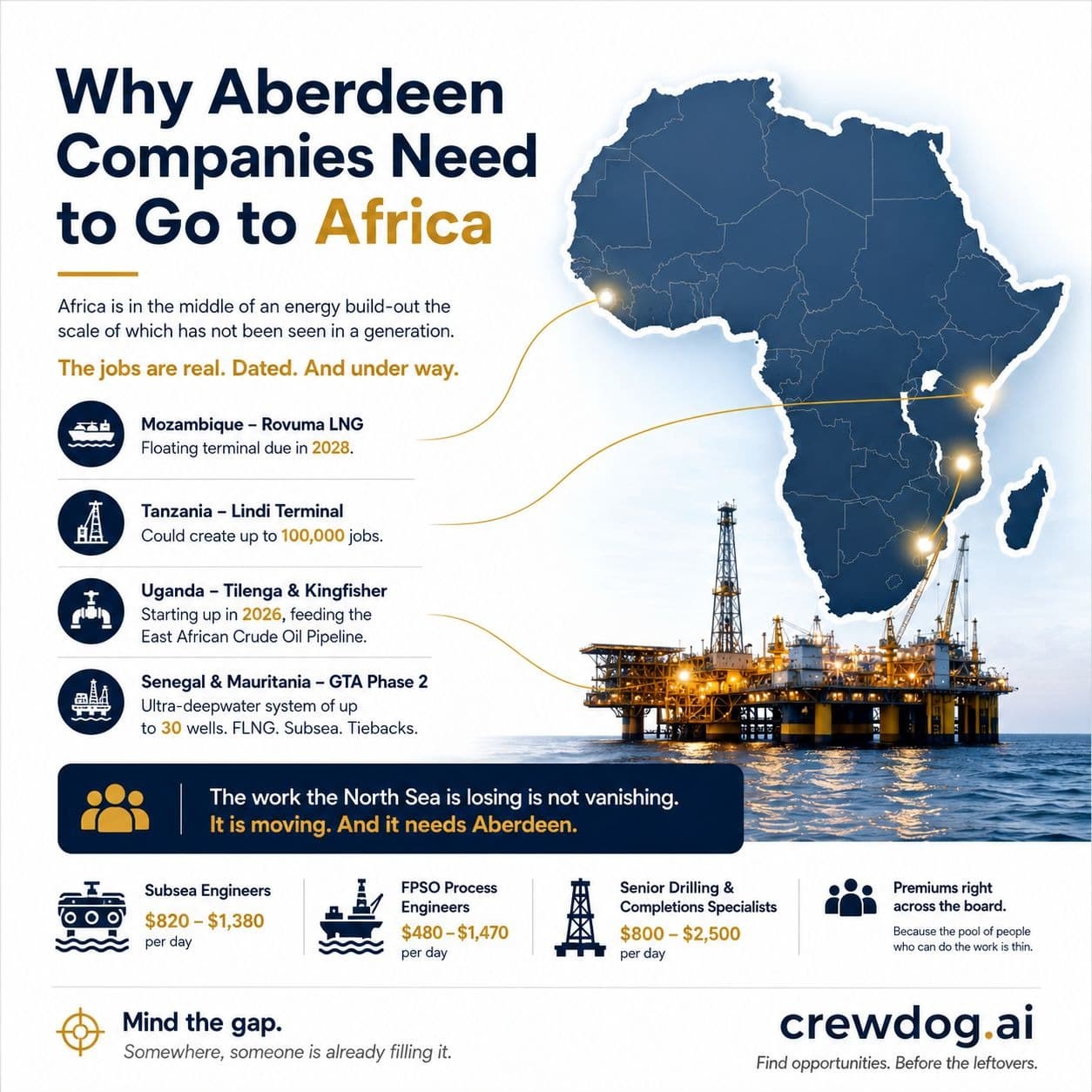
While the North Sea sheds close to a thousand jobs a month, a different map is lighting up.
Africa is in the middle of an energy build-out the scale of which has not been seen in a generation, and it needs the exact discipline Aberdeen has spent fifty years perfecting.
The jobs are real, dated and under way.
Mozambique's Rovuma LNG, with a floating terminal due in 2028.
Tanzania's Lindi terminal, which could create up to a hundred thousand jobs.
Uganda's Tilenga and Kingfisher fields, starting up in 2026 and feeding the East African Crude Oil Pipeline to the coast.
And off Senegal and Mauritania, the next phase of Greater Tortue Ahmeyim, an ultra-deepwater system of up to thirty wells.
FLNG. Subsea tiebacks. Deepwater wells. Floating production. The same majors that built Aberdeen, TotalEnergies, ExxonMobil, Shell, Equinor, BP, are the ones building Africa.
Why does this matter to Aberdeen?
Because the work the North Sea is losing is not vanishing. It is moving. And it is moving to the precise kind of project Aberdeen firms have spent half a century learning to deliver.
A subsea engineering house, a well-services outfit, an inspection or commissioning specialist, a fabrication yard: every one already holds the capability these developments are crying out for.
The roles attached carry real money.
Subsea engineers command roughly 820 to 1,380 US dollars a day. FPSO process engineers, 480 to 1,470. Senior drilling and completions specialists, 800 to 2,500.
More in CV Tips

Build your perfect CV
Use AI to create system-optimized resumes that land interviews. Free to start.
Get Started Free